
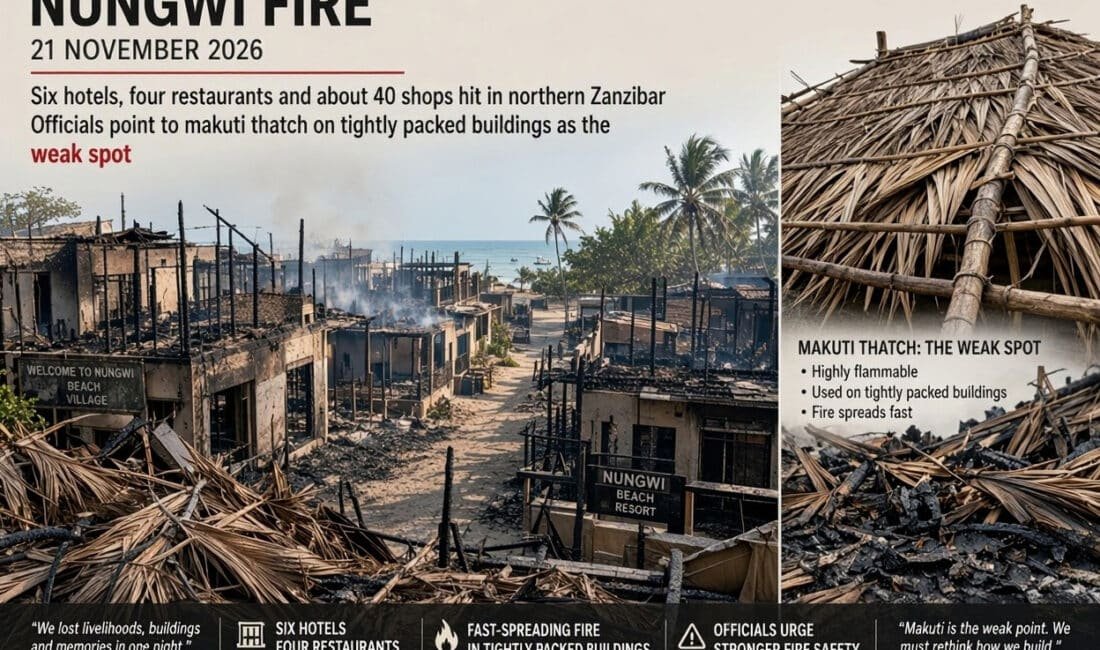
The Nungwi fire hit six hotels and exposed thatch as a weak spot.

Why the Nungwi fire matters beyond one beach
A weak spot was hiding in plain sight when the Nungwi fire began at Makofi Hotel on the afternoon of Saturday, 21 November: the flames ran across makuti roofs to the buildings next door. Zanzibar’s tourism minister, Dr Nasra Nassor Omar, told The Citizen that it took about three hours to bring the flames under control.
The minister named six hotels: Makofi, Z Hotel, Nungwi Garden, BR, Pasha and Sand Beach. Four restaurants and about 40 shops were also hit. Early findings point to a large flame in an oven used to bake bread. The thatch, made from woven palm leaves, helped the fire jump between buildings that stand close together.
The purpose of the official message is clear. The government wants to show that guests were safe and that the island is acting. That matters for a tourist hotspot. But the losses are real. Hotel owners, shopkeepers and restaurant staff lose income while they rebuild. Some guests lost bags and passports. Other investors may now face new costs for sprinklers and hydrants. Travellers could gain in the long run, if safer rules follow.
Guests were safe, but some lost their passports
Guests were safe, but all of them had to leave. Mwananchi reports that all 183 guests were moved to hotels in Mchangani and Matemwe. No tourist died or was injured. Some workers had minor injuries from panic and stress. A number of visitors lost their passports, and the ministry says it is working with their embassies to replace them. The Zanzibar Commission for Tourism says more than 20 hotels offered free rooms.
One hotel’s hydrant slowed the flames
One hotel’s hydrant slowed the flames before fire engines arrived, according to Suleiman Ali Mohamed, who chairs the Zanzibar Association of Tourism Investors. The minister also praised that equipment. Three fire stations in the region joined the response. After the fire was out, members of the JKU, a Zanzibar government brigade, guarded the site until morning to stop theft. Tanzania Times quoted witnesses who said local residents also helped to fight the blaze.
Thatch roofs now face hard questions
Thatch roofs now face hard questions. Arif Abbas Manji of the tourism commission urged investors to fit sprinklers in buildings with makuti roofs and to improve camera surveillance. In his words, sprinklers would have stopped the damage from reaching that level. TRT Afrika reports that the government may help with repairs once safety checks are done. Some details are still not settled. A district official listed damage at Nungwi Inn, while the minister named Nungwi Garden, and officials have not yet explained the difference.
Frequently Asked Questions
-
When and where did the Nungwi fire happen?
It broke out on the afternoon of Saturday, 21 November 2026, at Makofi Hotel in Nungwi, on the northern tip of Unguja, Zanzibar’s main island. The minister said it took about three hours to control.
-
What caused the fire?
Early findings point to a large flame in an oven used to bake bread. Makuti thatch roofs on closely built properties helped the fire spread. The final cause has not been officially confirmed.
-
Was anyone hurt?
No deaths were reported and no tourist was injured. Some workers had minor injuries linked to panic and stress during the evacuation.
-
What happened to the guests?
All 183 guests were moved to hotels in Mchangani and Matemwe. More than 20 hotels offered free rooms. The ministry is working with embassies to replace lost passports.
-
Which properties were affected?
The minister named Makofi, Z Hotel, Nungwi Garden, BR, Pasha and Sand Beach, plus four restaurants and about 40 shops. A district official also listed damage at Nungwi Inn.
Conclusion
The Nungwi fire did not take lives, and that is the most important fact. Yet the Nungwi fire exposes a weak spot that Zanzibar has seen before, in Paje in 2023 and in Jambiani in 2021. Thatch is part of the coast’s look. If the island wants to keep that look, it will need hydrants, sprinklers and space between buildings. Owners pay first. Guests and workers gain the most if the rules change. Across the Indian Ocean, another island nation that lives on beach hotels is rethinking its own rules, as the Maldives moves to kill an operator tax. Far away, Vietnam rewrites its tourism rulebook to bring in more visitors.
Bibliography / Sources
- Mikofu, J. (2026, November 22). Massive fire sweeps through six hotels, 40 shops in Zanzibar’s tourist hotspot Nungwi. The Citizen. https://www.thecitizen.co.tz/tanzania/zanzibar/massive-fire-sweeps-through-six-hotels-40-shops-in-zanzibar-s-tourist-hotspot-nungwi-5679972
- Mwananchi (2026, November 22). Moto wateketeza hoteli sita, maduka 40 Nungwi, wageni wapoteza pasipoti. Mwananchi. https://www.mwananchi.co.tz/mw/zanzibar/habari/moto-wateketeza-hoteli-sita-maduka-40-nungwi-wageni-wapoteza-pasipoti-5679942
- TRT Afrika (2026, November 22). Zanzibar : les touristes des hôtels incendiés ont été transférés vers d’autres sites. TRT Afrika. https://www.trtafrika.com/francais/article/8b3379801703