


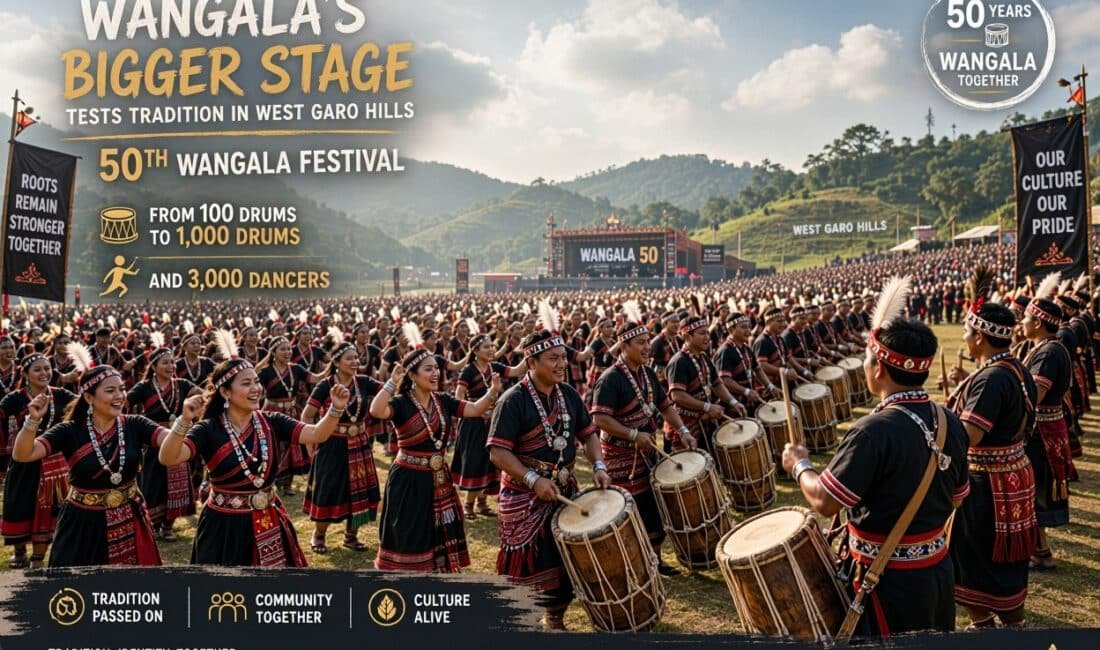
Wangala’s bigger stage tests tradition as a harvest rite meets a tourist crowd.
Why Wangala’s bigger stage tests tradition
Wangala’s bigger stage tests tradition as the 50th Hundred Drums Festival fills a field at Wangala A’dam, Chibragre. The event runs from 11 to 14 November 2026. Chief Minister Conrad K. Sangma opened it on 11 November. Opening-day reports put 1,000 drummers and 3,000 dancers on the ground, under the theme “Rhythm of 1,000 Drums.”
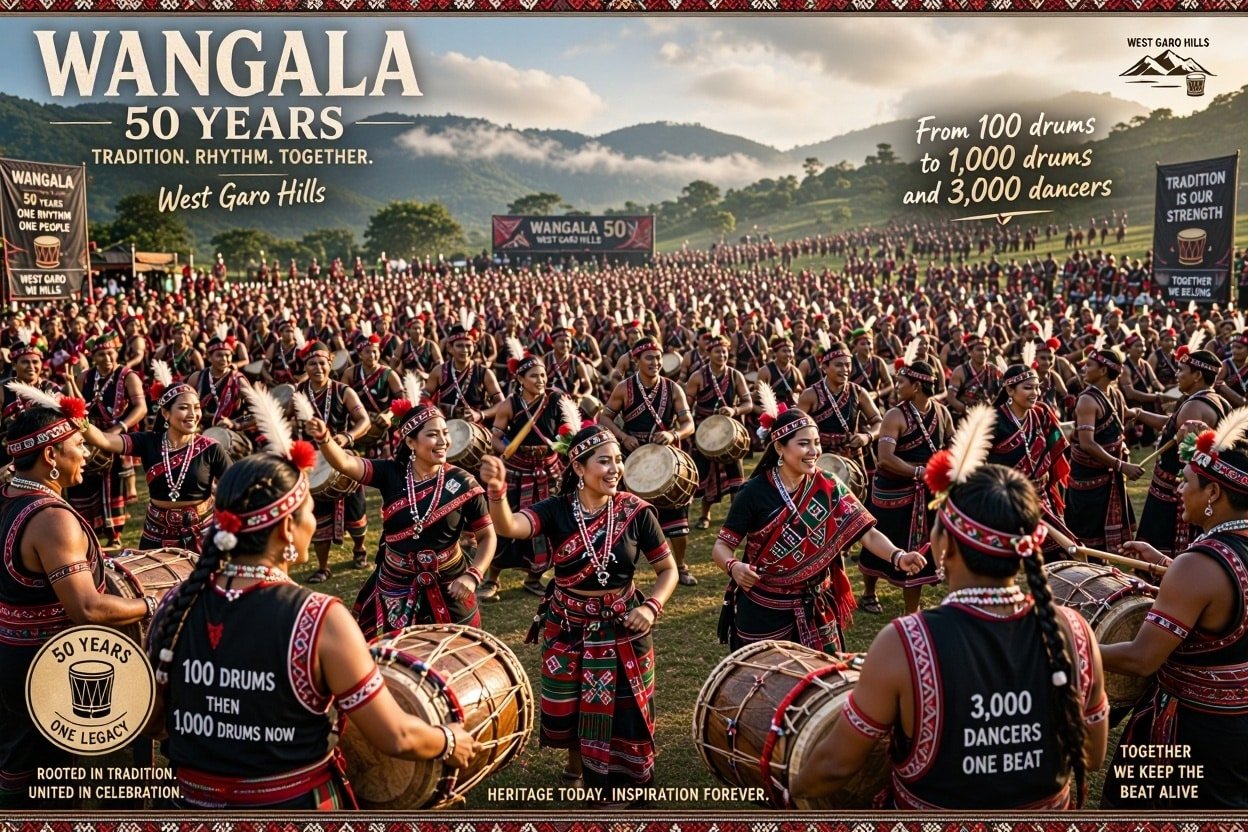
The organised festival began in 1976 with 100 drums and 300 dancers. It was built to keep a Garo harvest rite alive when some village celebrations were fading. The rite gives thanks to Misi Saljong, the sun deity, after the harvest. This year’s scale is meant to honour that history and to draw visitors. The chief minister also announced funds for the site, the festival and a Guinness World Records attempt.
If the bigger stage works, Garo troupes, local stallholders and the host district can gain attention and trade. Travellers can see the rite at a rare scale. The risk is that a harvest thanksgiving becomes a show built around a record. That record is still only an attempt, set for 14 November. Until Guinness reviews the evidence, it should not be sold as a done result.
The organised festival grew from a much smaller harvest gathering
The organised festival grew from a much smaller harvest gathering of 100 drums and 300 dancers in 1976. Opening-day coverage this week described 1,000 drummers and 3,000 dancers, with troupes invited from neighbouring states.
That growth can help a tradition travel farther than a single village can. It can also change what the day feels like. A field built for visitors is not the same as a village thanksgiving after harvest.
A record attempt is not the same as a record
A record attempt is not the same as a record, and that distinction matters while the festival is still under way. Organisers plan a formal Guinness World Records try on 14 November, the closing day, with 1,000 traditional drums.
Until Guinness reviews the evidence, no title has been confirmed. A tourism pitch that treats the record as already won would oversell the week.
Local hosts gain only if visitors stay for the rite
Local hosts gain only if visitors stay for the rite, not only for a closing-day spectacle. More than 300 stalls for food, handloom and handicrafts were reported at the site, giving artisans a chance to sell during the four days.
The host district can gain if guests spend beyond a single performance. It gains less if the crowd talks only about a record that has not been confirmed.
Frequently Asked Questions
-
When and where is the 50th Wangala Festival?
It runs from 11 to 14 November 2026 at Wangala A’dam, Chibragre, in West Garo Hills, Meghalaya.
-
How large is this year’s edition?
Opening-day reports described 1,000 drummers and 3,000 dancers, up from 100 drums and 300 dancers when the organised festival began in 1976.
-
Has a Guinness World Record been confirmed?
No. A formal attempt with 1,000 drums is planned for 14 November. It remains an attempt until Guinness reviews the evidence.
-
What is Wangala for?
It is a Garo harvest festival that gives thanks to Misi Saljong, the sun deity, after the harvest.
-
Who may gain or lose from the bigger stage?
Troupes, stallholders and the host district may gain visitors and trade. The harvest rite may lose focus if the week is framed mainly as a record bid.
Conclusion
Wangala’s bigger stage tests tradition by turning a village harvest rite into a four-day public gathering of 1,000 drums and 3,000 dancers. If that scale works, performers, stallholders and the host district can gain, and visitors can see a living ceremony at rare size. The loser may be the quieter meaning of the rite, especially if the week is sold around a Guinness attempt that has not been confirmed. The attempt is due on 14 November. Until a record is actually awarded, the honest story is a harvest festival that has grown, not a world title already won.
Bibliography / Sources
- India Today North East. (2026, November 11). Meghalaya marks 50 years of Wangala festival with 1,000 drums and 3,000 dancers. https://www.indiatodayne.in/meghalaya/video/meghalaya-marks-50-years-of-wangala-festival-with-1000-drums-and-3000-dancers-1474198-2026-11-11
- Highland Post. (2026, November 11). Rhythm of 1,000 drums: Wangala turns 50. https://highlandpost.com/rhythm-of-1000-drums-wangala-turns-50/
- Government of Meghalaya. (2026, October 28). 50 Years of Wangala Festival: Meghalaya Gears Up for a Historic Celebration of 1,000 Drums. https://www.meghalaya.gov.in/index.php/press/content/52221